Transaction placements rarely fail on price. They fail on surprises: an exclusion the client did not expect, a schedule nobody noticed was missing, a binder that quietly differs from the quote. Each is preventable with reading that nobody had time to do.
Five ordinary failure points
isn't in the data room"] --> X["Underwriter excludes
the rep"] B["A rep with no diligence
behind it"] --> X C["A disclosed issue the client
thought was covered"] --> Y["Client surprised
at the NBI"] D["Authority or conflicts
handled by email"] --> Z["Placement outside
policy"] E["Binder differs from the
selected quote"] --> W["Policy differs
from the deal"] style X fill:#fdecec,stroke:#e57373 style Y fill:#fff4e2,stroke:#f4a03a style Z fill:#fdecec,stroke:#e57373 style W fill:#fdecec,stroke:#e57373
1. The missing schedule
Reps say “except as set forth on Schedule 3.13”. If Schedule 3.13 is not in the data room, the rep cannot be underwritten. InsightDealDesk’s reps agent records every schedule each rep relies on and raises a missing-document finding when one is absent.
2. The uncovered rep
A data privacy rep with no cyber diligence is the classic narrowed rep. The diligence gap agent maps each rep to the reports that cover its area and flags the rest, by name and section.
3. The surprise exclusion
Disclosed matters are known to the buyer; quantified diligence findings are likely deal-specific exclusions. The exclusion agent lists both before the submission goes out, so the client hears it from the broker.
4. Authority by email
A limit above a broker’s authority, or a quote selected before conflicts clear, should not depend on someone remembering. Placement controls in the Rules Studio block or refer, and the supervisor agent prepares the sign-off brief.
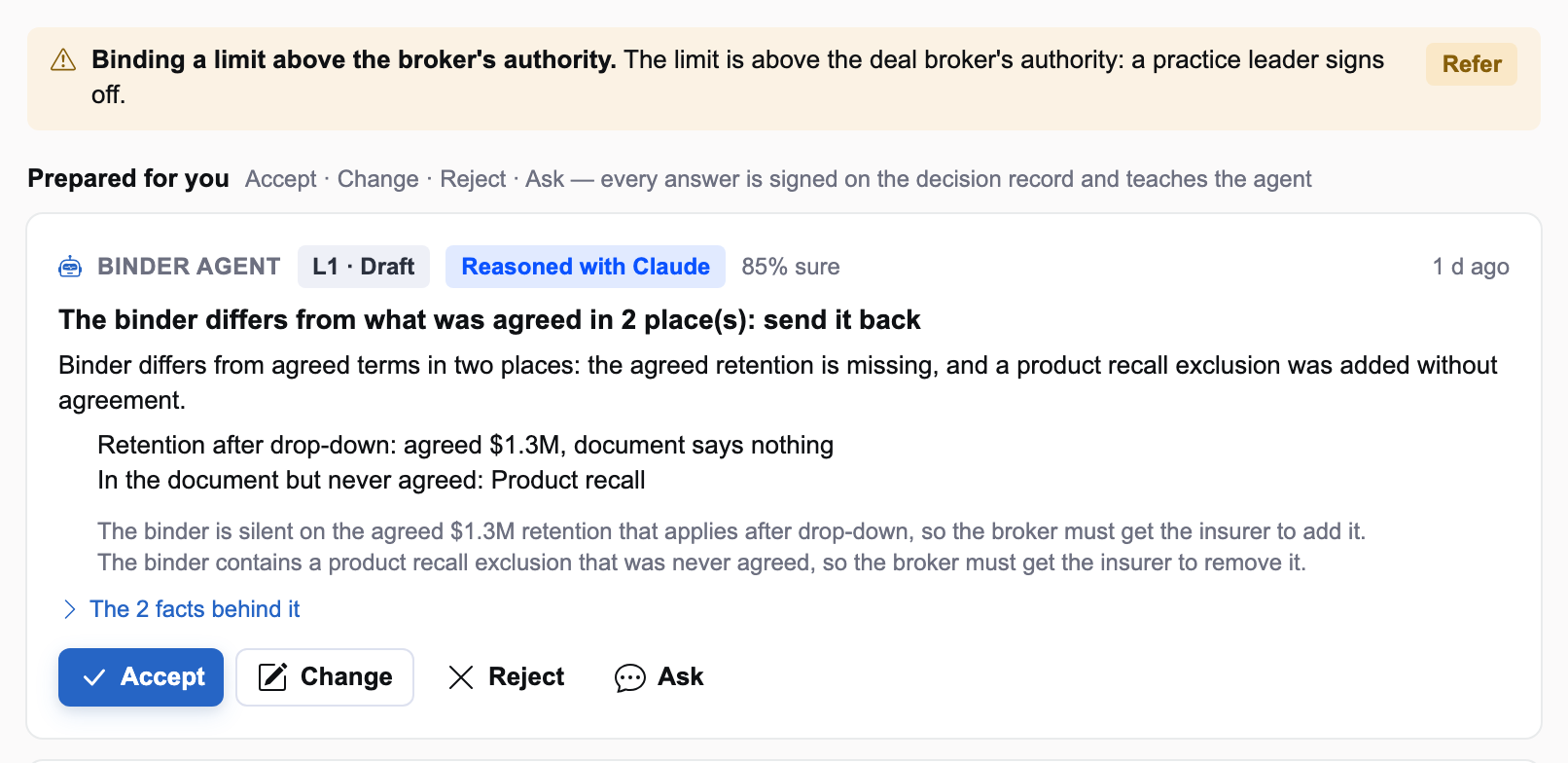
5. The binder nobody checked
The binder agent checks the binder against the selected quote field by field, and the policy against the binder.