The AI-first workbench for R&W, tax and contingent liability insurance on M&A deals. Eleven agents read the agreement and the diligence, predict the exclusions, compare the quotes and check the binder — every finding cited to its page. Nothing goes to a market, and nothing is bound, until a broker decides.
11agents; every placement action capped at ask-first
~1¢model cost of a full Analyze on a demo deal
Illustrative: figures from the fictional demo book shown on this site. Your deals will differ.
Deal Workspace · Project Alder
Prepared for you · Quote agent
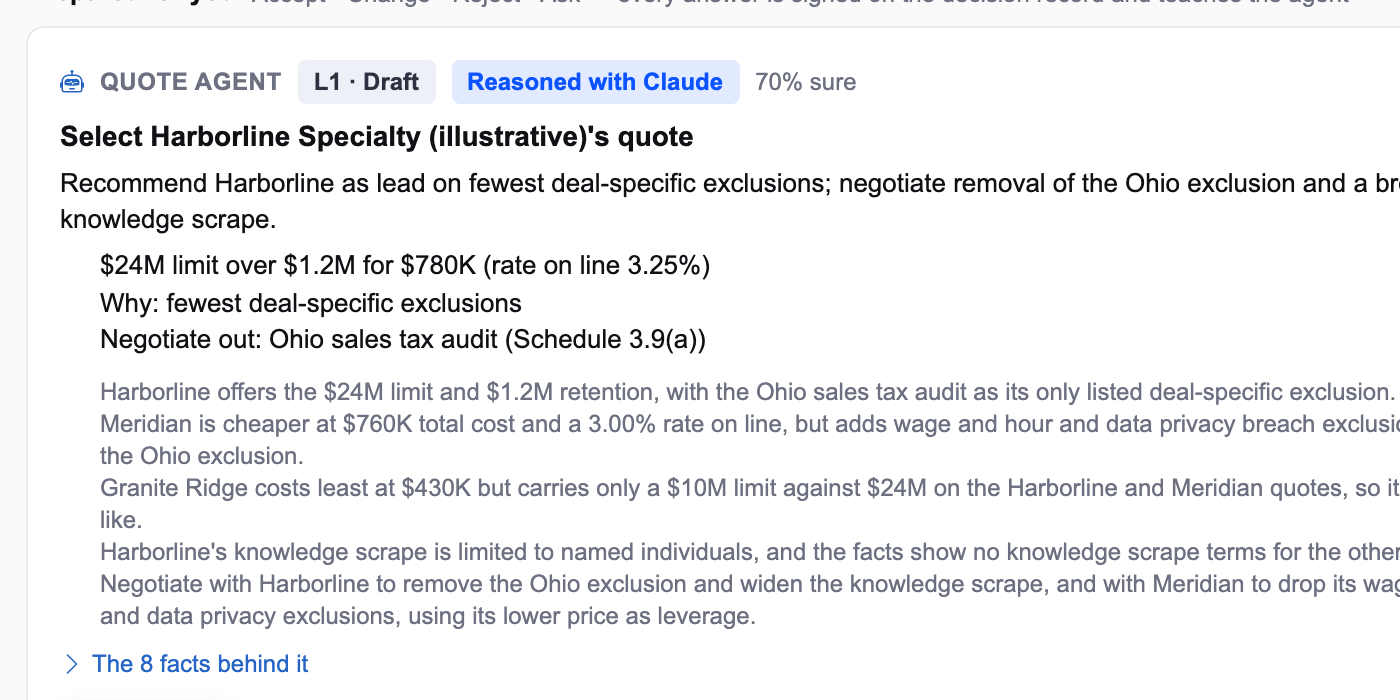
Project Alder (illustrative): three quotes in, and the quote agent’s recommendation waiting for a broker to accept, change, reject or ask.
Built for a broker’s transaction risk practice
Representations & warrantiesTax insuranceContingent liabilityBuyouts and carve-outsMid-market to large-capPrimary and excess towers
Proof, not promises
Three screens from the demo book, as they are
The running product on fictional deals. The agents’ text is what Claude wrote for them; every figure is the engines’. Click a screen for the full page.
Markets & quotes · Quotes side by side
1
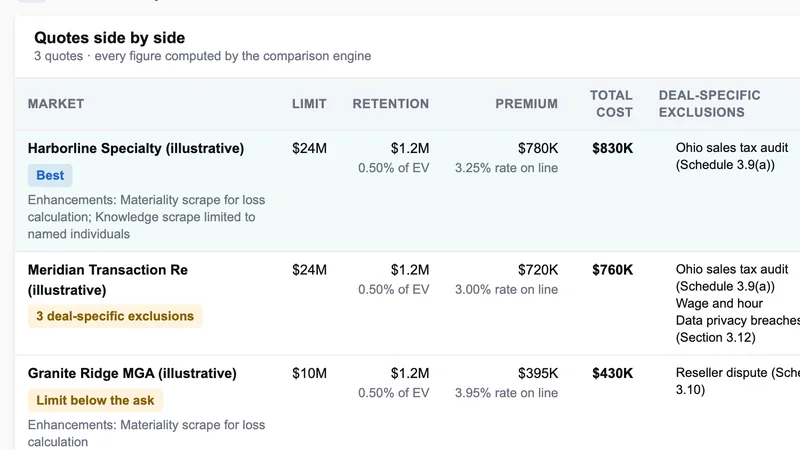
Three quotes, one grid nobody re-keyed
The comparison engine computes retention as a share of EV, rate on line and total cost, and lines up the deal-specific exclusions and the wording that differs.
The quote agent reads that grid — not the PDFs — and prepares a recommendation for a broker to accept, change, reject or ask.
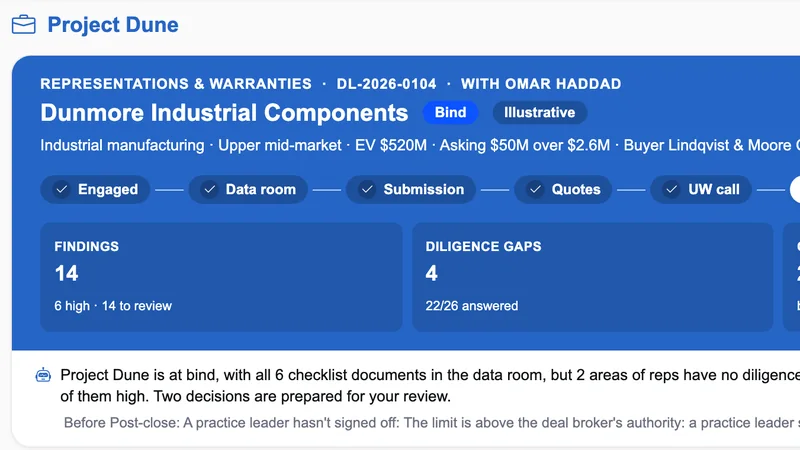
Every rep with its qualifier, its schedule, the diligence report behind it and the page it was read from. A data privacy rep with no cyber diligence shows red.
Those are the reps an underwriter narrows — so the diligence gap agent raises them before the submission, not at the indication.
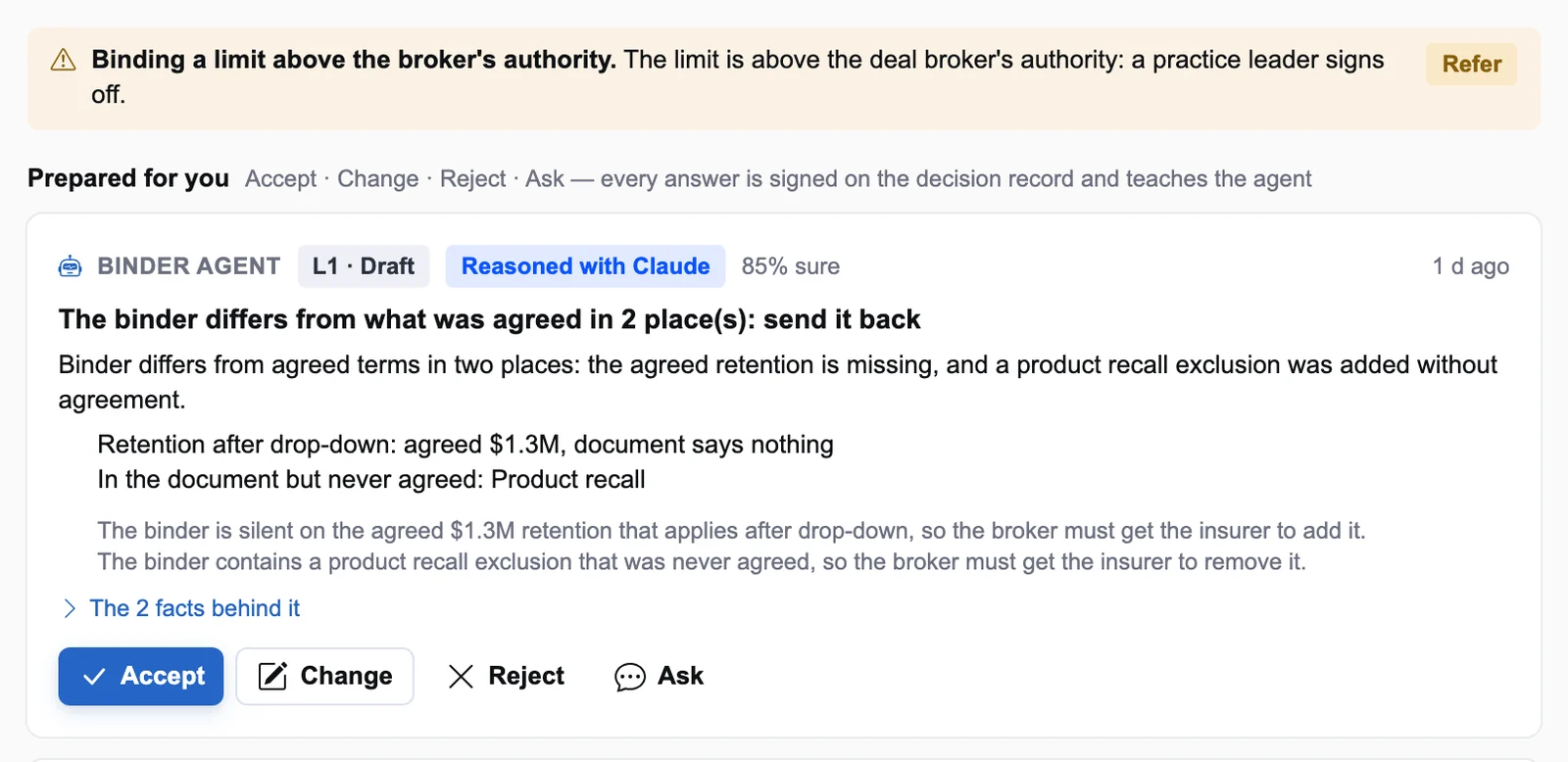
The agreed $1.3M drop-down retention is missing and a product recall exclusion appeared that nobody agreed. The binder agent says so, cites both, and prepares the send-back.
A placement is three weeks of reading and an afternoon of judgement
The judgement is what the client pays for. The reading — every rep, schedule and diligence report, every market’s appetite, every quote revision — is what the day is spent on.
Surprises
The exclusion nobody predicted
A disclosed audit or a quantified diligence finding becomes a deal-specific exclusion the client hears about at the indication.
Coverage
Reps with nothing behind them
A data privacy rep with no cyber diligence is the rep an underwriter narrows — and the one most likely to be claimed on.
Speed
A grid rebuilt per revision
Limit, retention, premium, fees, rate on line and exclusions, re-keyed every time a market revises.
E&O
A binder nobody checked
A drop-down retention missing, an exclusion added — and the binder becomes the policy.
The product
One workbench from mandate to post-close
A workspace per deal, eleven agents that prepare the work, and the controls that keep them inside a broker’s authority.
Every step after the button is something a broker can open and check.
1
You press Analyze
Or What would they do? — a dry run that writes nothing.
2
The data room is read
Into page-level pieces (InsightXtract in production), so every citation points at a page.
3
Facts gathered
Reps, schedules, diligence, InsightPulse intelligence, the engines’ market fit and quote grid.
4AI
Claude reasons
Over the cited facts, in a fixed shape: findings, a recommendation, what to negotiate.
5
Grounding check
A number that is not in the facts throws the answer away; the agent’s own findings stand.
6
A broker decides
Accept, change, reject or ask — signed on the decision record and counted as evidence.
Capped at ask-first. Sending a submission, approaching markets, selecting a quote, accepting a binder and signing off always wait for a person with the authority.
The agents prepare; the engines compute every figure; a broker decides. Each step is traced with its model, tokens and cost.
The agents
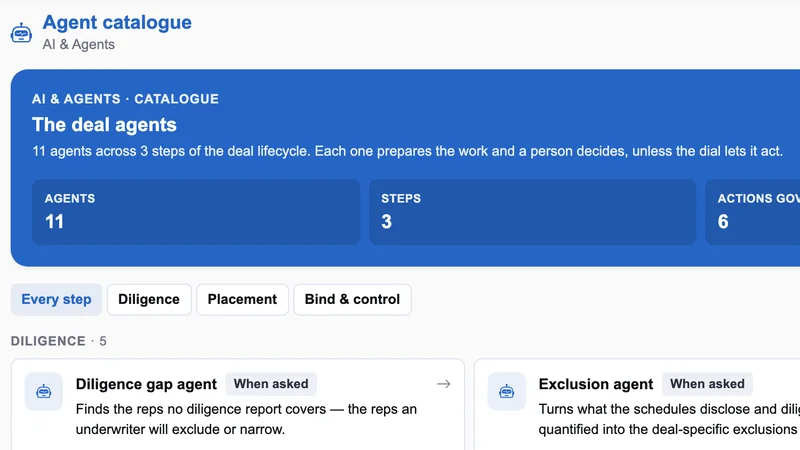
Eleven deal agents, each with one job and a hard limit
Every action that commits the client or the brokerage — sending a submission, approaching markets, selecting a quote, accepting a binder, signing off — is capped at ask first, whatever the dial says.
Data room
The data room against the placement checklist; drafts the request for what is missing.
Reps
Every rep, its qualifier — knowledge, materiality or flat — and the schedules it relies on.
Diligence gap
The reps no diligence report covers: the ones an underwriter will narrow.
Exclusion
Disclosed and quantified issues turned into the deal-specific exclusions to expect.
Intelligence
The target’s company 360, subsidiaries, leadership and news from InsightPulse.
Submission
The package and cover note, disclosing known issues and gaps.
Prepares the send; never sends
Market
Fit per market — lines, sector, size, capacity, retention — with every reason.
Capped at ask first
Quote
The engine’s comparison, a recommendation and what to negotiate out.
Capped at ask first
UW call
The questions underwriters will ask, answered from the data room.
Binder
Binder against the quote, policy against the binder, field by field.
Capped at ask first
Supervisor
Runs the placement controls; prepares the practice leader’s sign-off.
Prepares; a leader signs
The autonomy dial
The level for any action is the lowest of three: the agent’s level for that action and sector, the action’s hard cap, and the tenant ceiling. Here the cap and the ceiling are both L2.
L1
Draft
The agent drafts; the broker does the work. Where every action starts.
Cap and ceilingL2
Ask first
The agent prepares the decision; a broker with the authority accepts, changes, rejects or asks.
L3
Act and tell
Locked for placement actions.
L4
Act
Locked for placement actions.
AI & Agents · Catalogue
Catalogue. Eleven agents in three steps, their actions and what each never invents.
Market agent · Trace
Run trace. The facts, the model call with tokens and cost, and what it prepared.
AI & Agents · Autonomy
Autonomy. The ceiling, the levels and each agent’s action.
AI & Agents · Activity
Activity. Every step on the book and what is waiting on a broker.
Controls
Placement policy as rules you can read, and a record of every decision
Rules Studio
Controls as sentences
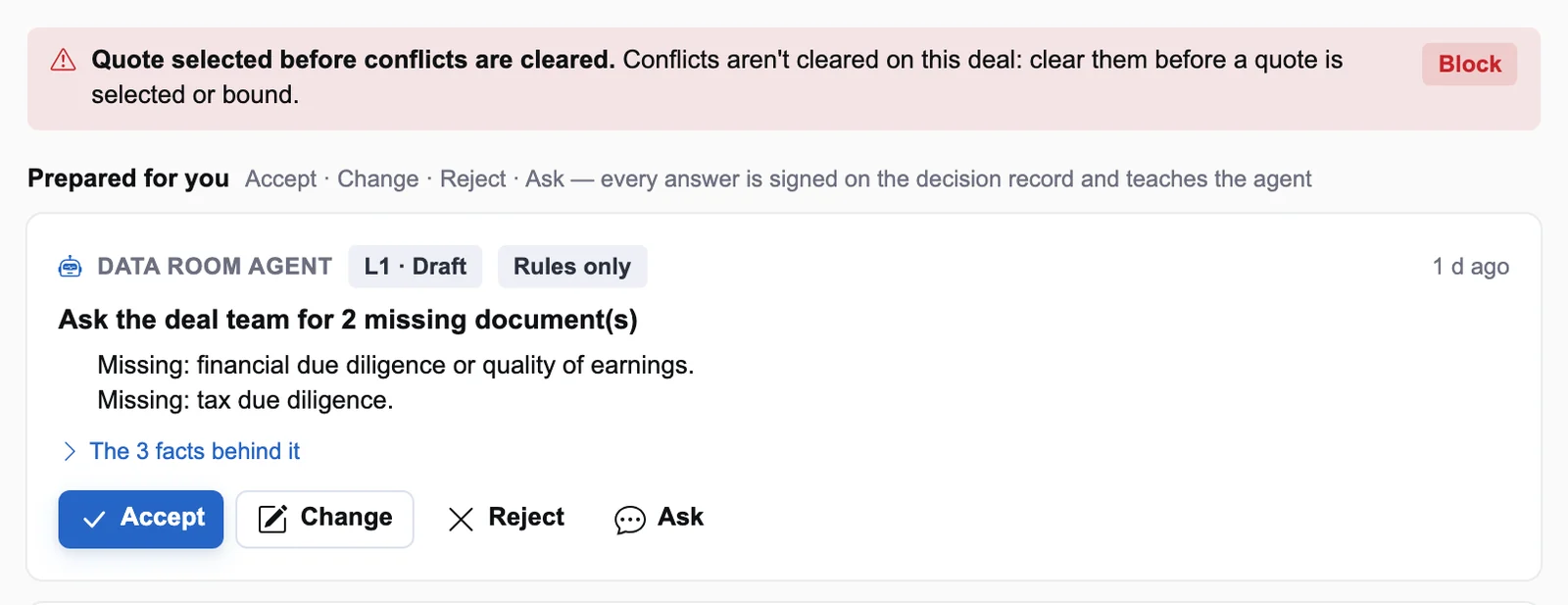
Conflicts not cleared blocks quote selection; a limit above the broker’s authority refers to a practice leader; a retention outside 0.5%–1% of EV warns. Tested against a real deal and versioned.
Binder check
Field by field
Insurer, limit, retention, drop-down, premium, exclusions, enhancements and conditions — missing, added or different, graded by severity.
Decision record
Signed answers
Every control hit, every prepared decision, every answer with its note and every sign-off — replayable for a client, an auditor or an E&O reviewer.
Decision · Binder agent
Binder check. The drop-down retention missing and an exclusion nobody agreed — send it back.
Decision · Placement control
Block. No quote is selected or bound until conflicts are cleared.
Rules Studio
Rules Studio. The placement controls, their hits and the busiest rules.
Connected
Insurance diligence in, company intelligence in, documents read
InsightDealDesk works on its own data room. With its sibling products, the target’s diligence, intelligence and documents arrive as data, each exchange signed.
Does an agent send a submission or bind on its own?
No. Sending, approaching markets, selecting a quote, accepting a binder and signing off are capped at ask-first whatever the dial says. Outside production every send is a dry run.
What stops the model inventing a premium?
The engines compute every figure. An agent answer with a number that is not among its cited facts is discarded and the agent’s own findings stand, labelled as such.
What does a run cost?
The trace records tokens and cost on every step. On the illustrative deals shown here a full Analyze of eleven agents cost about one cent; your deals will differ.
Are the markets on this site real?
No. Every market, deal, target, person and figure on this site is fictional and labelled illustrative.
See the agents work a deal
Bring an anonymised data room from a deal you have placed and watch the agents predict the exclusions, compare the quotes and check the binder in a 30-minute walkthrough.