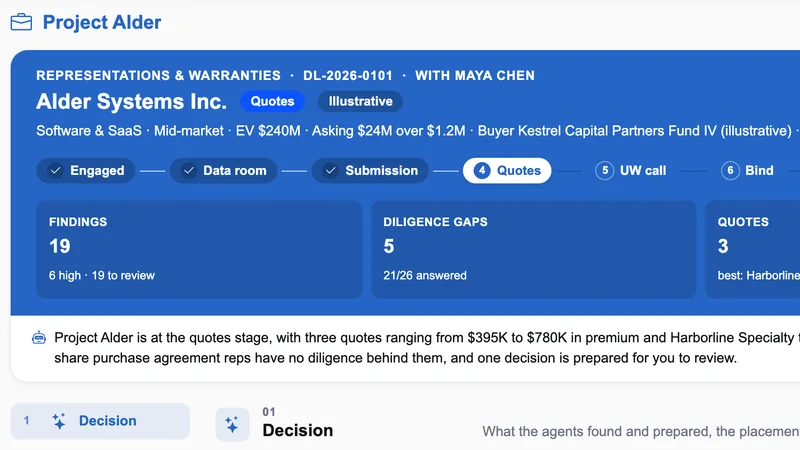
Representations and warranties insurance protects a buyer against loss from a breach of the seller’s reps in the purchase agreement. Placing it is a compressed, document-heavy sprint that runs in parallel with the deal itself — and almost all of it is reading.
The shape of a placement
sponsor calls"] --> C["Conflicts and
engagement"] C --> D["Data room:
SPA, schedules, DD"] D --> S["Submission to
selected markets"] S --> N["Non-binding
indications"] N --> SEL["Select a market,
pay the UW fee"] SEL --> U["Underwriting call"] U --> B["Binder at signing"] B --> P["Policy after closing"]
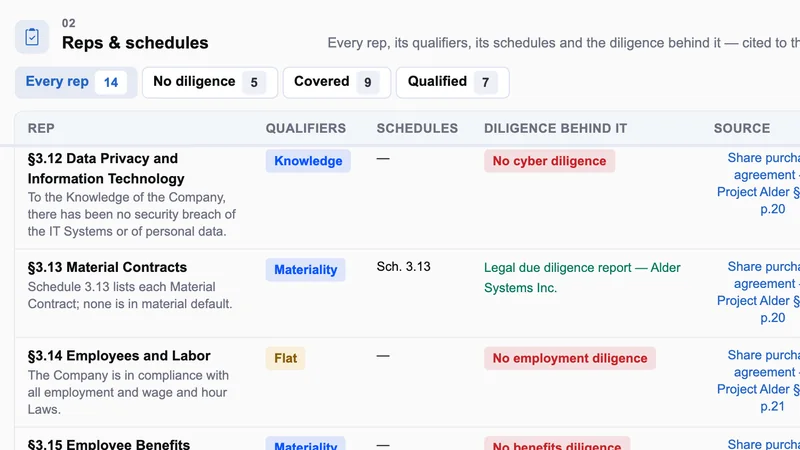
Each arrow hides days of reading. The broker reads the SPA for its reps and how each is qualified — knowledge, materiality, or flat. They read the disclosure schedules, because anything disclosed is known to the buyer and will be excluded. They read every diligence report, because a rep with no diligence behind it will be excluded or narrowed. Then they predict, for the client, what the policy will exclude before any underwriter writes it down.
Where the hours go
| Task | What it involves today |
|---|---|
| Data room triage | Reconciling a checklist against a data room index that changes daily. |
| Rep inventory | Copying reps into a grid with their qualifiers and schedule references. |
| Diligence mapping | Working out which report covers which rep, and which reps nothing covers. |
| Exclusion forecast | Turning disclosed and quantified issues into the exclusions to expect. |
| Market selection | Remembering each market’s appetite for sector, size, capacity and retention. |
| Quote comparison | A hand-built grid of limit, retention, premium, fees and exclusions. |
| UW call prep | Finding the passages that answer the questions underwriters always ask. |
| Binder check | Comparing the binder with the selected quote, line by line, the night before signing. |
None of these is a judgement call on its own. Together they are the evidence a judgement call needs: which market to lead with, what to push back on, when to tell the client a rep is uninsurable. That split — reading for the agents, deciding for the broker — is what InsightDealDesk is built around.
The same placement in InsightDealDesk
Illustrative throughout
Every deal, market and figure on this site comes from InsightDealDesk’s fictional demo book. Nothing here describes a real transaction, insurer or client.