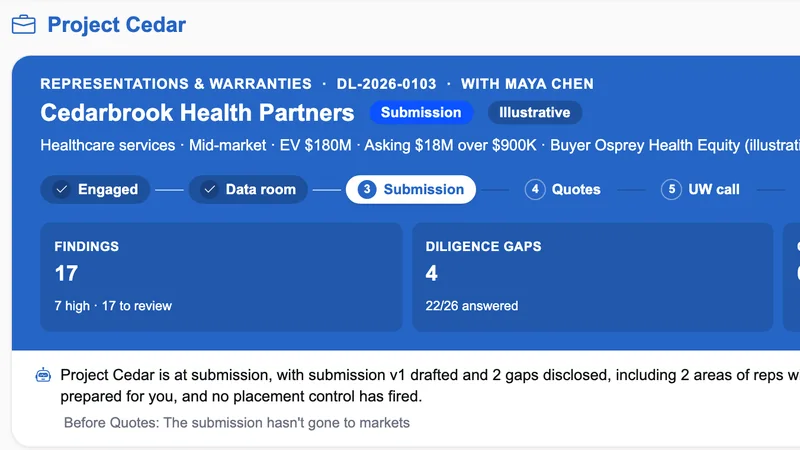
An infrastructure fund is buying a freight business for $410 million and wants $40 million of R&W cover. The data room holds the purchase agreement, the schedules and a financial diligence report — and nothing else. The sponsor wants the submission out this week.
This post follows Project Birch (illustrative) through the data-room stage: what the agents say about a half-built data room, how the submission is drafted so it discloses its gaps instead of hiding them, which markets the market agent would approach, and why a practice leader has to sign off. Birchway Logistics, the fund and the markets are fictional.
| Actors | Deal broker ($15M authority), practice leader, the sponsor's deal team |
|---|---|
| Deal | Project Birch Illustrative — transport & logistics, EV $410M |
| Ask | $40M R&W limit over $2.05M (0.5% of EV) |
| Data room | SPA, disclosure schedules, financial DD — no tax, legal or specialist diligence |
| Agents involved | Data room, reps, diligence gap, exclusion, intelligence, submission, market, supervisor |
| Prepared decisions | Ask the deal team for two documents; send submission v1; approach four markets; practice leader sign-off |
| Outcome | The broker knows what is missing, what the submission will say about it, and who signs off before binding |
| What is measured | Days in data room, documents requested vs received, gaps disclosed in the submission |
The problem with an incomplete data room
Underwriters price what diligence covers. A rep with no diligence behind it is either excluded or priced as if the buyer knows nothing — and a submission that goes out without saying which reps are uncovered invites a surprise at the non-binding indication. The usual fix is a checklist in a spreadsheet that the broker reconciles by hand against the data room index.
schedules, financial DD"] --> I["Data room agent:
playbook checklist"] I -->|"3 of 6 present"| RQ["Prepared: ask the deal team
for tax and legal DD"] DR --> G["Diligence gap agent:
rep areas uncovered"] G -->|"7 areas"| SUB["Submission agent:
cover note discloses gaps"] DR --> X["Exclusion agent:
Joliet stormwater notice,
customer concentration"] X --> SUB SUB --> MK["Market agent:
shortlist by appetite"] MK --> SV{"Supervisor:
limit above authority"} SV -->|refer| PL["Practice leader
sign-off brief"] style RQ fill:#fef3c7,stroke:#b45309 style PL fill:#e8f8f4,stroke:#22c1a4,stroke-width:2px
Step by step
The R&W placement playbook asks for six things. Three are present. Tax and legal diligence are missing and required; specialist diligence is optional and also absent. It prepares the request to the deal team with the two required items. Nothing is emailed: the request is logged for the broker to send.
Knowledge-qualified §3.10, §3.12 and §3.17; materiality-qualified §3.7, §3.11, §3.13 and §3.15; the rest flat.
Tax (§3.9), compliance (§3.11), cyber (§3.12), employment (§3.14), IP (§3.17) and environmental (§3.16) reps have nothing behind them — the last one despite a disclosed stormwater violation.
Schedule 3.16 discloses a notice of violation at the Joliet terminal with remediation estimated at $300,000; the financial DD reports 41% of revenue from two customers.
Version 1 of the package: the deal, the diligence in the room, two known issues as proposed exclusions, seven areas with no diligence, and the company context. The cover note is the model’s, every fact in it cited; sending it is prepared, not done.
Meridian and Summit are strong and cover the ask; Northwind and Harborline are possible but short on capacity; Cobalt (no R&W) and Granite Ridge (deal size, capacity) are out.
BIND_ABOVE_AUTHORITY refers: $40M is above the broker’s $15M authority. The agent prepares the practice leader’s brief.
Accepts the information request, holds the submission until tax DD arrives, accepts the shortlist.
Only a practice leader or compliance can accept a sign-off; anyone else gets a refusal, not a silent pass.
What the screens show


Disclosing a gap is the point
The submission agent does not dress up an incomplete data room. Its package has a section headed “Areas with no diligence”, populated from the gap findings. A broker can remove a line before sending — that is a Change, and it is recorded — but the default is that underwriters hear about the gap from the broker rather than find it themselves.
The four prepared decisions as a state machine
One live ask per agent and action: when Analyze runs again after the tax report lands, the old “send submission v1” is superseded by the new draft rather than left beside it. An identical re-run keeps the existing ask instead of creating a duplicate.
Who talks to whom
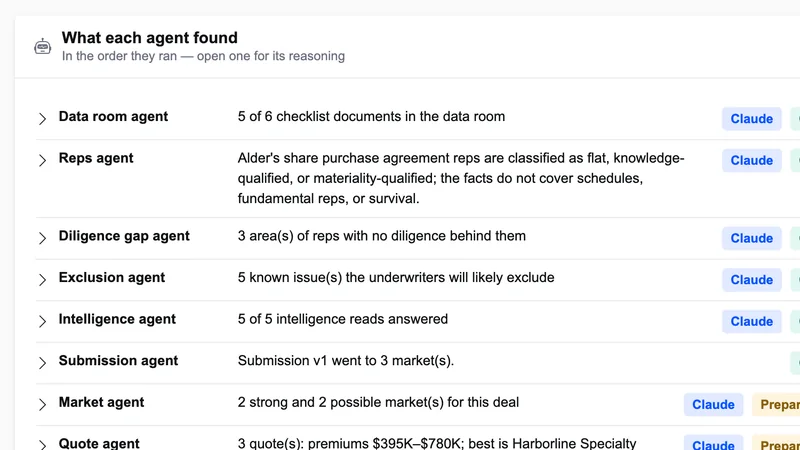
What the agents said
| Agent | What it prepared | What it cites | Who decides |
|---|---|---|---|
| Data room | Ask for tax DD and legal DD | Playbook checklist vs document categories | Broker |
| Diligence gap | Seven rep areas uncovered | SPA reps, DD coverage | — |
| Exclusion | Joliet stormwater notice; customer concentration | Schedule 3.16 p.3; financial DD p.4 | — |
| Submission | Send v1 to the shortlisted markets | 14 facts: deal, findings, gaps | Broker |
| Market | Approach Meridian and Summit first | Appetite: sector, size, capacity, retention | Broker |
| Supervisor | Practice leader sign-off | BIND_ABOVE_AUTHORITY, roster authority | Practice leader |
Edge cases
| What happens | What InsightDealDesk does |
|---|---|
| The broker tries to move to Submission with no SPA | The stage machine refuses and lists why. |
| Quotes are entered before submission is sent | Quotes stage needs a sent submission; the move is refused with that reason. |
| A broker without lead rights accepts the sign-off | Refused: only a practice leader or compliance signs off a placement outside policy. |
On the deal desk
Four asks, each with its reasons. The broker spends the day chasing the two missing reports, not building the checklist.
For IT and architecture
The checklist is the pack’s playbook (rw_placement), not code; adding an item is a pack change.
For practice leaders
The authority control turns a judgement call into a recorded sign-off with a brief, every time.
Questions we get asked
Does the request go to the deal team automatically?
No. Outside production every send is a dry run; in production it still waits for the broker's accept.