Healthcare services targets carry reps that a software deal never sees: billing federal programs in compliance with the law, coding, licensure, physicians’ employment status. They are also where diligence most often finds a number — and where underwriters most often write a deal-specific exclusion.
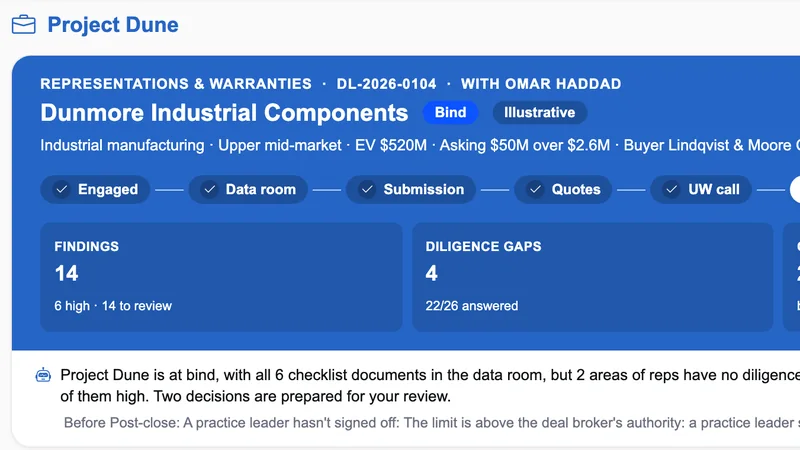
Project Cedar (illustrative) is a $180 million acquisition of a physician group by a health-focused fund, asking $18 million of R&W cover over $900,000. The data room is complete: SPA, schedules, quality of earnings, tax, legal and HR diligence. This post follows it through submission. Every name and figure is fictional.
| Actors | Deal broker ($25M authority), placement lead, practice leader |
|---|---|
| Deal | Project Cedar Illustrative — healthcare services, EV $180M |
| Ask | $18M over $900K (0.5% of EV) |
| Sector rep | §3.19 Healthcare Regulatory Compliance — billing federal healthcare programs |
| Known issues | Medicare billing audit at two clinics ($650K potential recoupment); pending wrongful termination claim; upcoding finding ($1.1M extrapolated) |
| Prepared decisions | Send submission v1; approach four markets |
| Outcome | A submission whose cover note names the healthcare exclusions underwriters will expect, sent to markets that write the sector |
Healthcare reps and what diligence says about them
regulatory compliance"] --- L["Legal DD:
upcoding risk, $1.1M
extrapolated"] R11["§3.11 Compliance
with laws"] --- L S["Schedule 3.19:
Medicare TPE audit,
$650K recoupment"] --- R19 R14["§3.14 Employees"] --- H["HR DD: physicians
as contractors"] R7["§3.7 Financial
statements"] --- Q["QoE: payer mix shift,
-3% reimbursement"] R12["§3.12 Data privacy"] --- N1["No cyber DD"] R16["§3.16 Environmental"] --- N2["No environmental DD"] style N1 fill:#fdecec,stroke:#e57373 style N2 fill:#fdecec,stroke:#e57373 style L fill:#fef3c7,stroke:#b45309 style S fill:#fef3c7,stroke:#b45309
The reps agent adds the sector rep because the target is healthcare services: the SPA’s §3.19 says the company has billed federal healthcare programs in compliance with applicable law in all material respects. The exclusion agent then reads the schedule against it: a targeted probe and educate (TPE) review at two clinics, with a potential recoupment, is disclosed — and a disclosed matter is known to the buyer, so an underwriter will exclude it.
Step by step
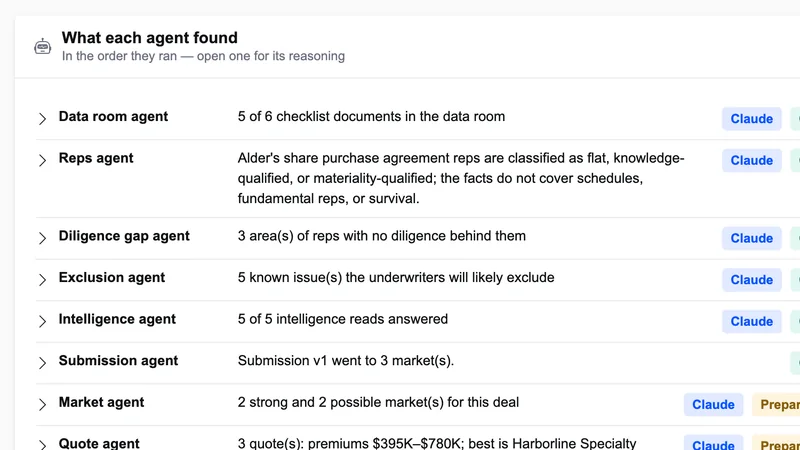
Every required checklist item is present; no request is prepared.
Three knowledge-qualified, five materiality-qualified, seven flat, including the healthcare rep.
Data privacy (§3.12) and environmental (§3.16) have no diligence. For a physician group holding patient data, the first matters.
The Medicare audit and the wrongful termination claim from the schedules; the upcoding finding (high, quantified), the payer-mix shift and the contractor classification from diligence.
A new chief executive since June after the founder retired — not adverse, but an underwriter will ask whether knowledge-qualified reps name the right people.
Cover note: an $18M R&W placement on a healthcare services target; known financial, legal, billing and employment issues proposed as exclusions; cyber and environmental reps lack diligence.
Harborline and Meridian strong — both write healthcare services at this size; Northwind and Granite Ridge possible with stated gaps; Summit out because it excludes healthcare services; Cobalt out because it writes no R&W.
No placement control fires: conflicts cleared, retention in band, limit inside authority.
Accepts the shortlist, reviews the cover note, accepts “send submission v1”. The deal moves to Quotes.
What the screens show

Why a market is out, in one sentence
The market agent’s fit is not a score. Each market’s appetite — lines written, target and excluded sectors, deal size range, capacity, usual retention band — is matched rule by rule, and every result carries its reasons. “Out: excludes healthcare services” is something a broker can repeat to a client; a 0.42 is not.
EV $180M, $18M over $900K"] --> L{"Writes R&W?"} L -->|no| O1["Out"] L -->|yes| S{"Sector excluded?"} S -->|yes| O2["Out"] S -->|no| Z{"EV in range and
capacity covers ask?"} Z -->|both| R{"Retention in
usual band?"} Z -->|one short| P["Possible, with
the shortfall stated"] R -->|yes| ST["Strong"] R -->|no| P style ST fill:#e8f8f4,stroke:#22c1a4 style O1 fill:#f1f3fb,stroke:#8089a8 style O2 fill:#f1f3fb,stroke:#8089a8
Who talks to whom
What the agents said
| Agent | What it prepared | What it cites | Who decides |
|---|---|---|---|
| Exclusion | Medicare audit, wrongful termination claim, upcoding, payer mix, contractor status | Schedules 3.19 and 3.10; legal, QoE and HR reports | — |
| Intelligence | New CEO since June; payer audits of E&M coding rising in the sector | InsightPulse company and industry, as-of date | — |
| UW call | Two of three questions answered; QoE reconciliation not in the data room | Data room passages | — |
| Submission | Send v1 | Deal, findings, gaps | Broker |
| Market | Harborline and Meridian first | Appetite rules | Broker |
On the deal desk
The healthcare exclusions are in the cover note before an underwriter writes them into an indication.
For IT and architecture
The sector rep comes from the pack’s sector reps; the market fit is insight_broker.match, a pure function over the market rows.
For practice leaders
A placement that fails in healthcare usually fails on a regulatory exclusion the client never expected. This one tells them first.
Questions we get asked
Does InsightDealDesk judge whether the billing audit will result in a recoupment?
No. It reports what the schedule and diligence say, with the page, and predicts how an underwriter will treat a disclosed matter.