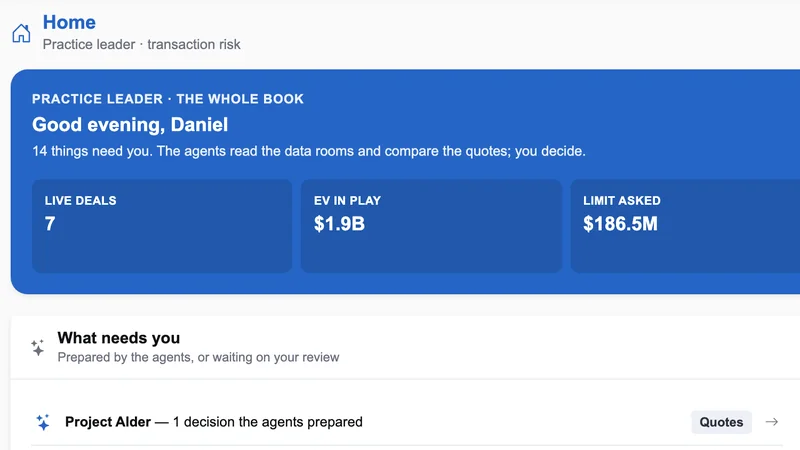
A $1.1 billion software deal wants $110 million of R&W cover. No single market in the book has that capacity. The placement becomes a tower — a primary and excess layers — and every layer has a binder, then a policy, to check.
Project Grove (illustrative) is the post-close deal in the demo book: bound, closed thirty days ago, with two quotes on file — Meridian at $50M and Summit at $40M, both over $5.5M. This post walks back through how a large deal is shaped and what the record holds after closing. Every name and figure is fictional.
| Deal | Project Grove Illustrative — software, EV $1.1B |
|---|---|
| Ask | $110M over $5.5M (0.5% of EV) |
| Quotes | Meridian $50M for $1.4M; Summit $40M for $1.1M — each flagged “limit below the ask” |
| Market fit | Zero strong, four possible: every market’s capacity is short of $110M |
| Binder check | One difference, none high |
| Control | BIND_ABOVE_AUTHORITY — refer |
| Outcome | A recorded tower decision, checked binders and a signed bind; the deal kept for its claims period |
When no market can carry the ask
The market agent’s reasons say it directly: “Capacity $50M — short of the $110M asked (a primary with excess, or a lower limit)”. That sentence is the start of the tower conversation with the client: buy the full limit across layers, or buy less.
drops after 12 months"] style L1 fill:#fef3c7,stroke:#b45309 style L2 fill:#f4f6ff,stroke:#8089a8 style L3 fill:#f4f6ff,stroke:#8089a8
An illustrative tower shape. In the demo book Grove carries the primary and one excess quote; the layers above are a sketch of the conversation, not data.
Step by step
Four possible markets, each short of the ask; the shortlist is prepared with the shortfall named for each.
Both quotes flagged below the ask; rate on line, total cost and conditions computed for each.
The client takes the primary and excess; the decision and its note are recorded.
One difference, not high; prepared for the broker with the field named.
Limit above the broker’s authority: the practice leader signs off the bind.
Bring-down no-claims declaration at closing, a condition on every quote in the book.
When the policy is issued it is checked against the binder, not the quote.
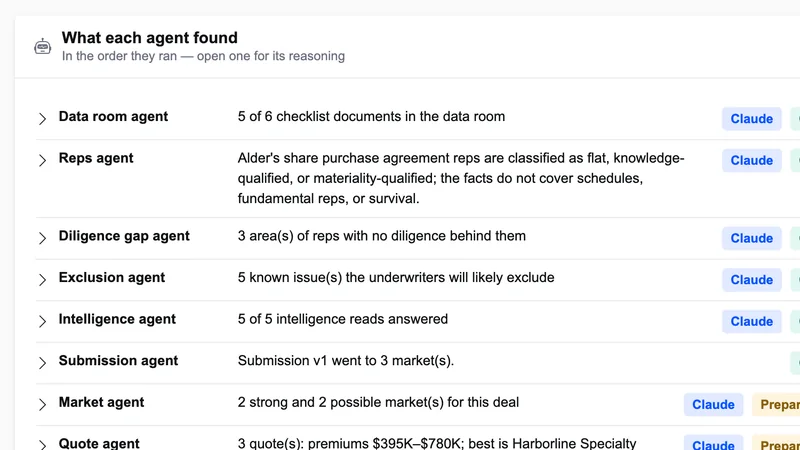
What the screens show

What stays on the record after closing
| Item | Why it matters later |
|---|---|
| The reps table with diligence behind each | A claim on a rep starts with what diligence covered and what was excluded. |
| Findings with their reviews | What was known to the deal team, and when — the known-breach exclusion turns on it. |
| Quotes, selection and the reasoning | Why this structure, signed by the broker. |
| Binder and policy checks | Evidence the policy matches what was agreed. |
| Control hits and sign-offs | Who approved a placement outside policy, with what note. |
| Agent | What it prepared | What it cites | Who decides |
|---|---|---|---|
| Market | Possible only; capacity short | Appetite: capacity vs $110M | Broker |
| Quote | Summit lowest-cost among those quoted; neither meets the ask | Comparison engine | Broker |
| Binder | One difference, none high | Binder check | Broker |
| Supervisor | Sign-off: limit above authority | Control, roster | Practice leader |
On the deal desk
The tower conversation starts from the market agent’s stated shortfall, not a hunch.
For IT and architecture
Binder and policy checks share one function; the expected document is the previous binder when a policy follows one.
For practice leaders
Large deals carry the most E&O exposure; this one has every step signed.
Questions we get asked
Does InsightDealDesk model excess layers?
Quotes carry their own limit and retention, and the engine flags a limit below the ask. Structuring the tower is the broker’s decision, recorded with its note.