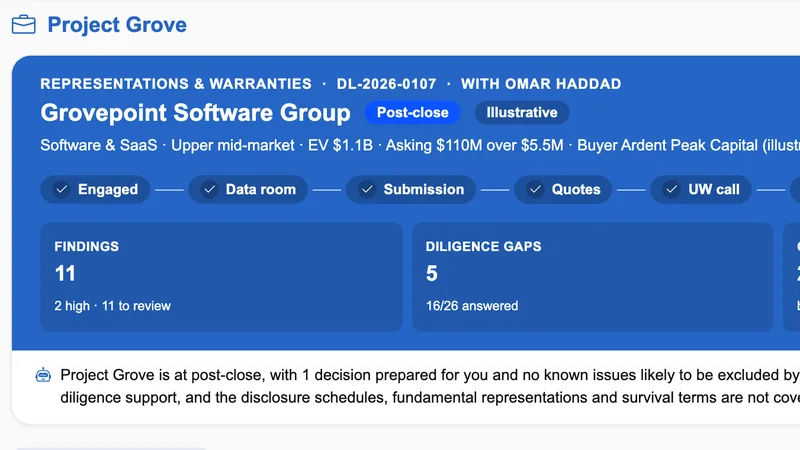
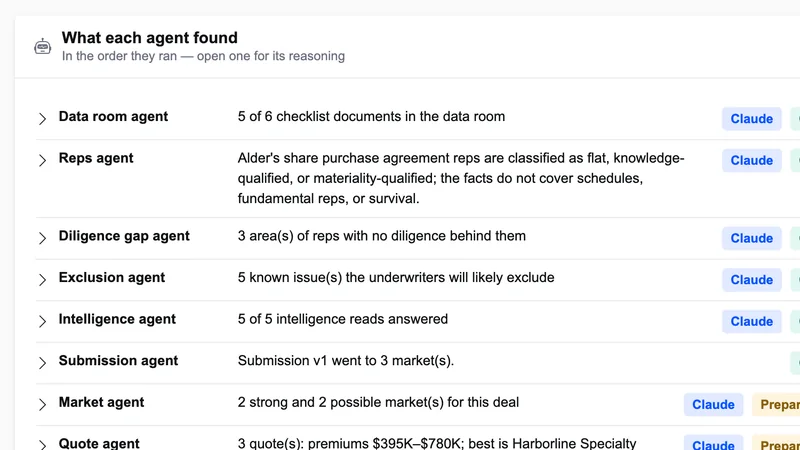
The underwriting call is where an R&W placement is won or narrowed. The underwriter has read the data room and will ask about every soft spot. A broker who can answer from the page — not from memory — keeps exclusions out of the policy.
Project Fjord (illustrative) is a $300 million payments business. The buyer wants $30 million of R&W and a tax policy beside it. The retention asked is $6 million — 2% of EV, well outside the usual band. The target confirmed a card data incident in March. Every name and figure here is fictional.
| Actors | Deal broker ($25M authority), placement lead, practice leader, the insurer's underwriter |
|---|---|
| Deal | Project Fjord Illustrative — financial services, EV $300M |
| Lines | Representations & warranties, and tax insurance |
| Ask | $30M over $6M (2% of EV) |
| Known issues | March card data incident (11,000 cardholders); PCI DSS remediation incomplete; UK–US transfer pricing undocumented; two money transmitter licences pending renewal |
| Controls | RETENTION_OUT_OF_BAND (warn), BIND_ABOVE_AUTHORITY (refer) |
| Outcome | Prepared answers to the call’s questions, cited; the retention question raised before the underwriter raises it |
Preparing the call
The UW call agent works the playbook’s underwriting section: the questions underwriters ask on almost every deal, answered from the data room with the passage cited — or marked as a gap the broker must close before the call.
revenue and EBITDA?"] --> S1{"Answer in
the data room?"} Q2["What tax exposures did tax DD find;
any indemnified separately?"] --> S2{"Answer in
the data room?"} Q3["What litigation is pending
or threatened?"] --> S3{"Answer in
the data room?"} S1 -->|no| G1["Gap: get it
before the call"] S2 -->|yes| A2["Transfer pricing undocumented;
no separate indemnity shown"] S3 -->|partly| A3["§3.10 knowledge-qualified;
Schedule 3.10 not in the facts"] style G1 fill:#fdecec,stroke:#e57373 style A2 fill:#e8f8f4,stroke:#22c1a4 style A3 fill:#fff4e2,stroke:#f4a03a
Step by step
Three findings at medium or high: the PCI DSS remediation (high, and fines from it are not insurable), the transfer pricing and the licences.
InsightPulse news: the March card data incident, cited with its date.
Meridian: $30M over $6M for $690K, excluding the incident and PCI DSS fines.
Two of three answered from the data room; the QoE reconciliation is a gap the broker must close.
The retention is outside 0.5%–1% of EV (warn); the limit is above the broker’s authority (refer). One sign-off brief covers both.
Asks the deal team for the QoE bridge, prepares the retention rationale, and asks the practice leader to sign off.
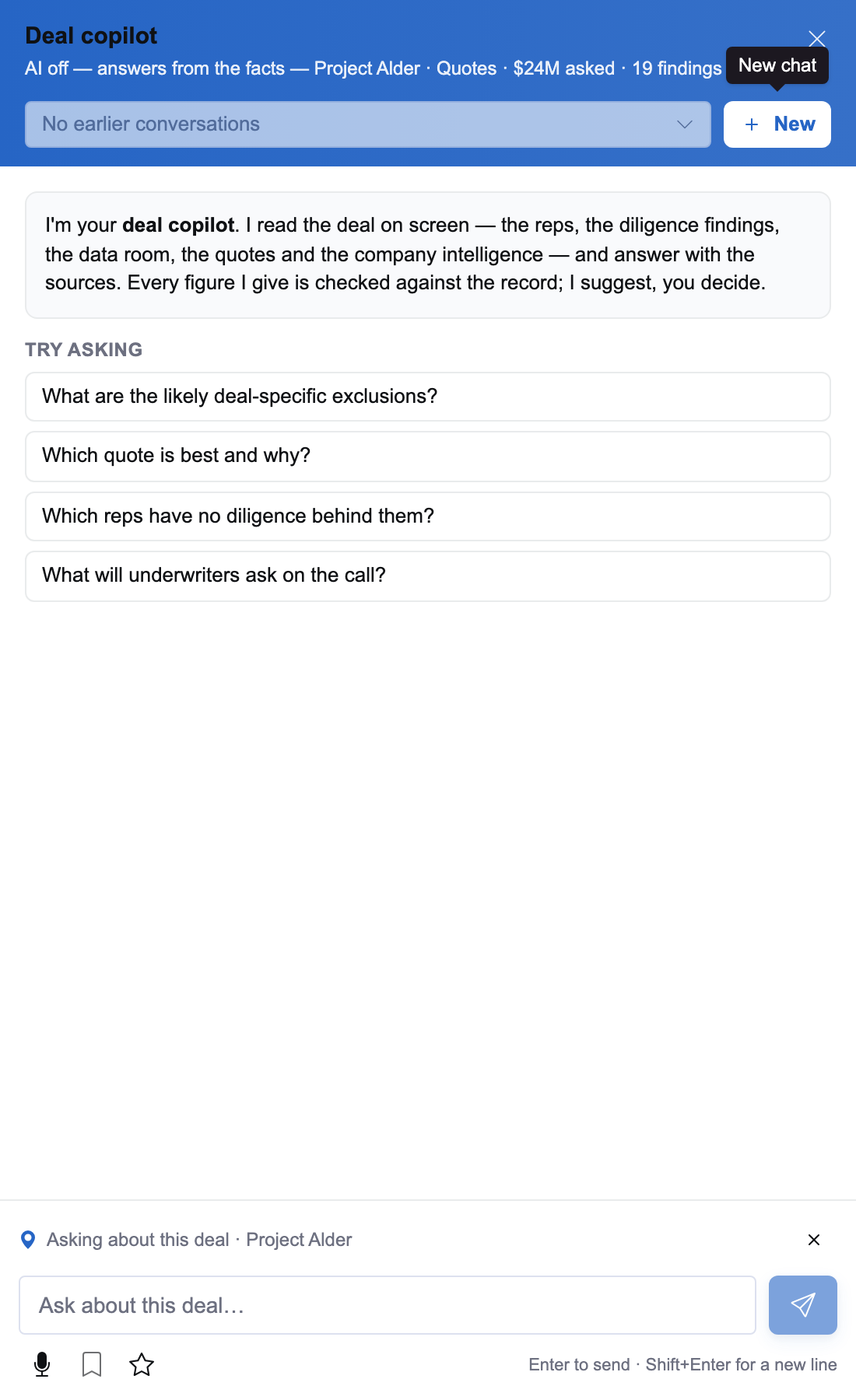
Answers with the cited passages open in the copilot.
What the screens show

Two lines on one deal
A deal can carry R&W, tax and contingent lines. The lines are part of the deal; the market agent matches each market on the lines it writes, so a tax specialist that writes no R&W is not shortlisted for the R&W layer but stays relevant for the tax policy.
| Agent | What it prepared | What it cites | Who decides |
|---|---|---|---|
| Exclusion | PCI DSS, transfer pricing, licences as likely exclusions | Cyber, tax and legal DD pages | — |
| UW call | 2 of 3 questions answered; QoE bridge missing | Data room passages | Broker |
| Supervisor | Sign-off: retention out of band, limit above authority | Two controls, roster | Practice leader |
On the deal desk
The call notes are the agent’s prepared answers with their pages. The broker spends prep time on the gap, not the known answers.
For IT and architecture
The copilot’s seven tools are read-only and re-check the asker’s scope on every call.
For practice leaders
The retention warning reaches a practice leader before the underwriter quotes on it.
Questions we get asked
Will the copilot answer during a live call?
It answers in seconds from the deal on screen, with sources. It never sends anything to the underwriter.