
A private equity sponsor is buying a mid-market software company for $240 million. Signing is three weeks out. The sponsor wants $24 million of representations and warranties cover over a $1.2 million retention, and three markets have quoted. The quotes differ on price, on limit and — most importantly — on which known issues each one excludes.
This post follows that deal, Project Alder, through InsightDealDesk from a populated data room to a recommendation the broker accepts or changes. Everything in it is illustrative: Alder Systems, the sponsor, the sellers and the three markets are invented for the demo book, and every figure is the demo’s, not a market benchmark.
| Actors | Deal broker (owner, $25M authority), placement lead, practice leader, the sponsor's deal team |
|---|---|
| Deal | Project Alder Illustrative — buyout of a software & SaaS target, EV $240M, Delaware SPA |
| Ask | $24M R&W limit over a $1.2M retention (0.5% of EV) |
| Data room | Share purchase agreement, disclosure schedules, quality of earnings, tax DD, legal DD |
| Agents involved | All eleven — the quote agent prepares the decision |
| Decisions and authority | Selecting a quote is the broker's, capped at ask-first; nothing is sent to a market from the product |
| Outcome | One recommended quote with its reasons, what to negotiate out, and the facts behind each line |
| What is measured | Days from quotes-in to selection, deal-specific exclusions negotiated out, agreement with the quote agent |
What quote comparison usually looks like
Three non-binding indications arrive as PDFs. Someone builds a comparison grid by hand — limit, retention, premium, underwriting fee, rate on line — and then reads each one for the deal-specific exclusions, which is where the real difference lives. The grid is accurate on Tuesday and stale by Thursday, when a market revises. The broker’s recommendation lives in an email.
as PDFs"] --> B["Hand-built grid:
limit, retention,
premium, fee"] B --> C["Exclusions read
one quote at a time"] C --> D["Recommendation
in an email"] D --> E["Client asks
why not the cheapest?"] style C fill:#fff4e2,stroke:#f4a03a style E fill:#fdecec,stroke:#e57373
InsightDealDesk changes two things. The grid is not built by anyone: the comparison engine computes every figure from the quotes as entered. And the exclusions are not discovered at the quote stage: the agents predicted them from the schedules and the diligence before the submission went out.
into cited pieces"] --> R["Reps agent:
qualifiers, schedules"] DR --> X["Exclusion agent:
disclosed and quantified issues"] R --> G["Diligence gap agent:
reps with no diligence"] X --> S["Submission discloses
known issues and gaps"] G --> S S --> Q["Quotes entered"] Q --> E["Comparison engine:
every figure"] E --> QA["Quote agent reasons
over the engine's figures"] QA --> P{"Broker: accept,
change, reject, ask"} style P fill:#e8f8f4,stroke:#22c1a4,stroke-width:2px style E fill:#fef3c7,stroke:#b45309
Step by step
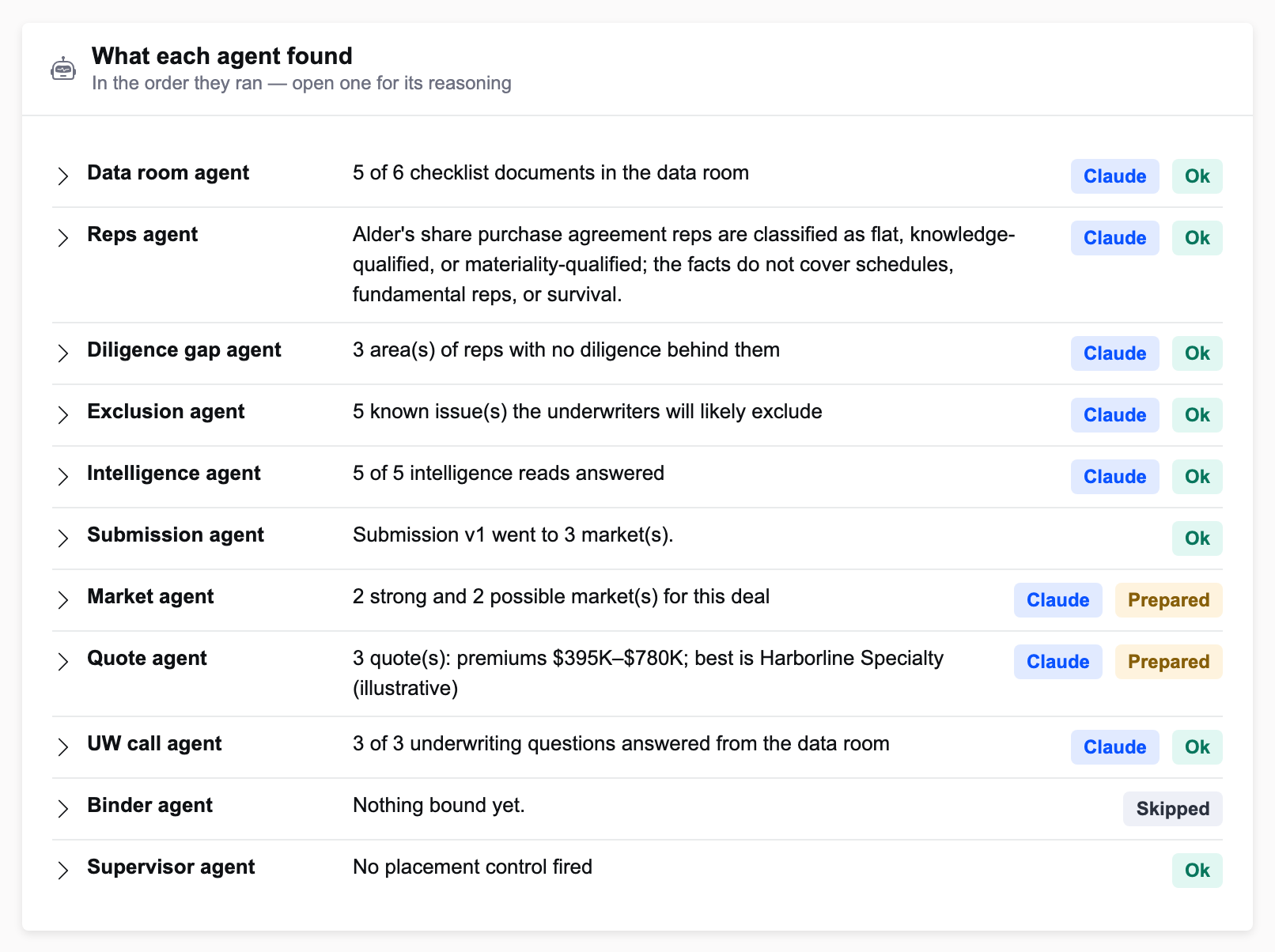
Five documents are read into page-level pieces: the SPA (23 pages, 15 pieces), the schedules, the QoE, the tax report and the legal report. Every later citation points at one of these pieces.
Fourteen reps, each tagged flat, knowledge-qualified or materiality-qualified, with the schedule it relies on. §3.10 Litigation and §3.12 Data Privacy are knowledge-qualified; §3.7 Financial Statements is materiality-qualified.
Five reps have no diligence behind them — cyber (§3.12), employment (§3.14), benefits, environmental and insurance. The agent notes that an underwriter will likely exclude or narrow them.
Schedule 3.9(a) discloses an Ohio sales tax audit with a proposed $1.2M assessment; Schedule 3.10 a reseller’s $450,000 commission demand. The QoE quantifies $2.4M of revenue recognised early. Each becomes a finding citing its page.
InsightPulse (here an illustrative stand-in) reports a security incident at the UK subsidiary in August. It becomes a red-flag finding cited “Pulse: news, as of” its date.
Harborline: $24M over $1.2M for $780K. Meridian: $24M over $1.2M for $720K. Granite Ridge: $10M over $1.2M for $395K. Each with its exclusions, enhancements and clause terms.
Retention as a share of EV, rate on line (3.25%, 3.00%, 3.95%), total cost with the underwriting fee ($830K, $760K, $430K), the deal-specific exclusions once the standard form ones are taken out, and the flags: Granite Ridge’s limit is below the ask.
Recommend Harborline as lead: the fewest deal-specific exclusions (only the Ohio audit), and enhancements — a materiality scrape for loss calculation and a knowledge scrape limited to named individuals. Negotiate out the Ohio exclusion; use Meridian’s lower price as leverage.
Conflicts are cleared, the retention is 0.5% of EV, and the $24M limit is inside the broker’s $25M authority: no placement control fires, so no sign-off is prepared.
Accept selects the quote and moves the deal to UW call; Change lets the broker pick another quote with a note; Reject closes the ask; Ask sends it back with a question. Each answer is signed on the record.
What the screens show


Why the cheapest quote is not the recommendation
Meridian is $60,000 cheaper on premium and $70,000 cheaper on total cost. It also excludes wage and hour and data privacy breaches on top of the Ohio audit. On a software target whose UK subsidiary disclosed a security incident in August and whose data privacy rep has no cyber diligence behind it, a data privacy exclusion is not a detail — it removes cover from the rep most likely to be claimed on. The quote agent says exactly that, cites the comparison rows and the red-flag finding, and leaves the call to the broker.
Every figure is the engine’s
The quote agent never computes a rate on line or a total cost. The comparison engine does, from the quotes as entered, and passes the results to the agent as facts. If the model’s answer contains a number that is not among those facts, the answer is discarded and the engine’s own pick stands, marked “rules only”.
Who talks to whom
The deal’s stages
What the agents said, and what each answer rests on
| Agent | What it prepared | What it cites | Who decides |
|---|---|---|---|
| Data room | 5 of 6 checklist documents present; specialist diligence missing | Data room documents by category | Broker |
| Reps | Reps classified flat, knowledge or materiality; schedules each relies on | SPA sections with page numbers | — |
| Diligence gap | Cyber, employment, benefits, environmental and insurance reps uncovered | SPA reps vs DD report coverage | — |
| Exclusion | Ohio sales tax audit, reseller dispute, early revenue recognition | Schedules 3.9(a) and 3.10; QoE p.4 | — |
| Intelligence | Security incident at the UK subsidiary | InsightPulse news, as-of date | — |
| Market | Two strong, two possible; Cobalt and Summit out | Each market's appetite rules | Broker |
| Quote | Select Harborline; negotiate out the Ohio exclusion | Comparison engine rows | Broker |
| UW call | Three underwriting questions answered from the data room | QoE, tax DD, Schedule 3.10 | — |
Edge cases
| What happens | What InsightDealDesk does |
|---|---|
| A market revises its quote | The new terms are entered; the next Analyze supersedes the open recommendation instead of stacking a second one. |
| The selected limit is above the ask | The LIMIT_ABOVE_ASK control refers it: confirm the client wants it. |
| Conflicts were never cleared | CONFLICTS_NOT_CLEARED blocks selection until they are. |
| No model is configured | The engine’s pick is prepared with the reasons it computed, labelled “rules only”. |
On the deal desk
The broker opens one page and sees the recommendation, the reason, the leverage and the facts. Changing it takes a note, not a new spreadsheet.
For IT and architecture
Figures come from insight_broker.compare; the agent’s output is validated against a findings schema and a grounding check before it is shown.
For practice leaders
Every selection carries its reasoning and the broker’s answer on the record — useful when a client later asks why a cheaper quote was passed over.
Questions we get asked
Does the agent pick the quote?
No. It prepares the selection; the broker accepts, changes, rejects or asks. Selecting a quote is capped at ask-first whatever the dial says.
Are these real markets?
No. Every market on this site is fictional and labelled illustrative, as are the deal, the target and the figures.
Keep reading
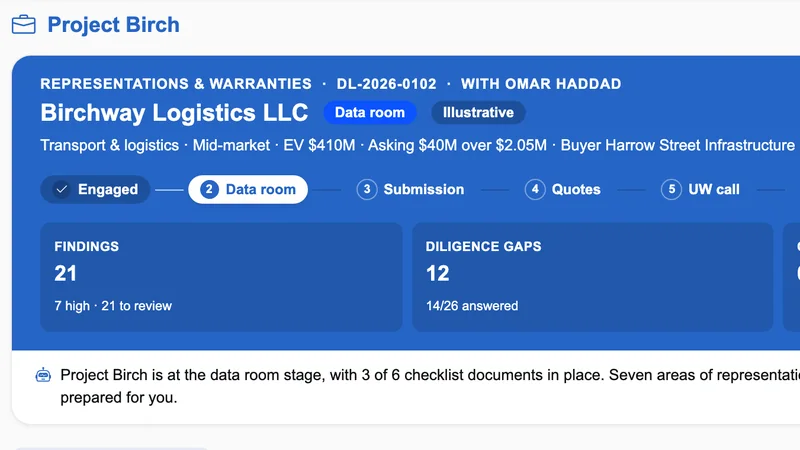
A logistics deal with half a data room
Three of six documents, seven rep areas with no diligence, and a limit above the broker's authority.
Company intelligence from InsightPulse
Subsidiaries, leadership, industry trends and adverse news, each with its as-of date.